
Instruments of the Ensemble

The Luvale Ngoma Drum
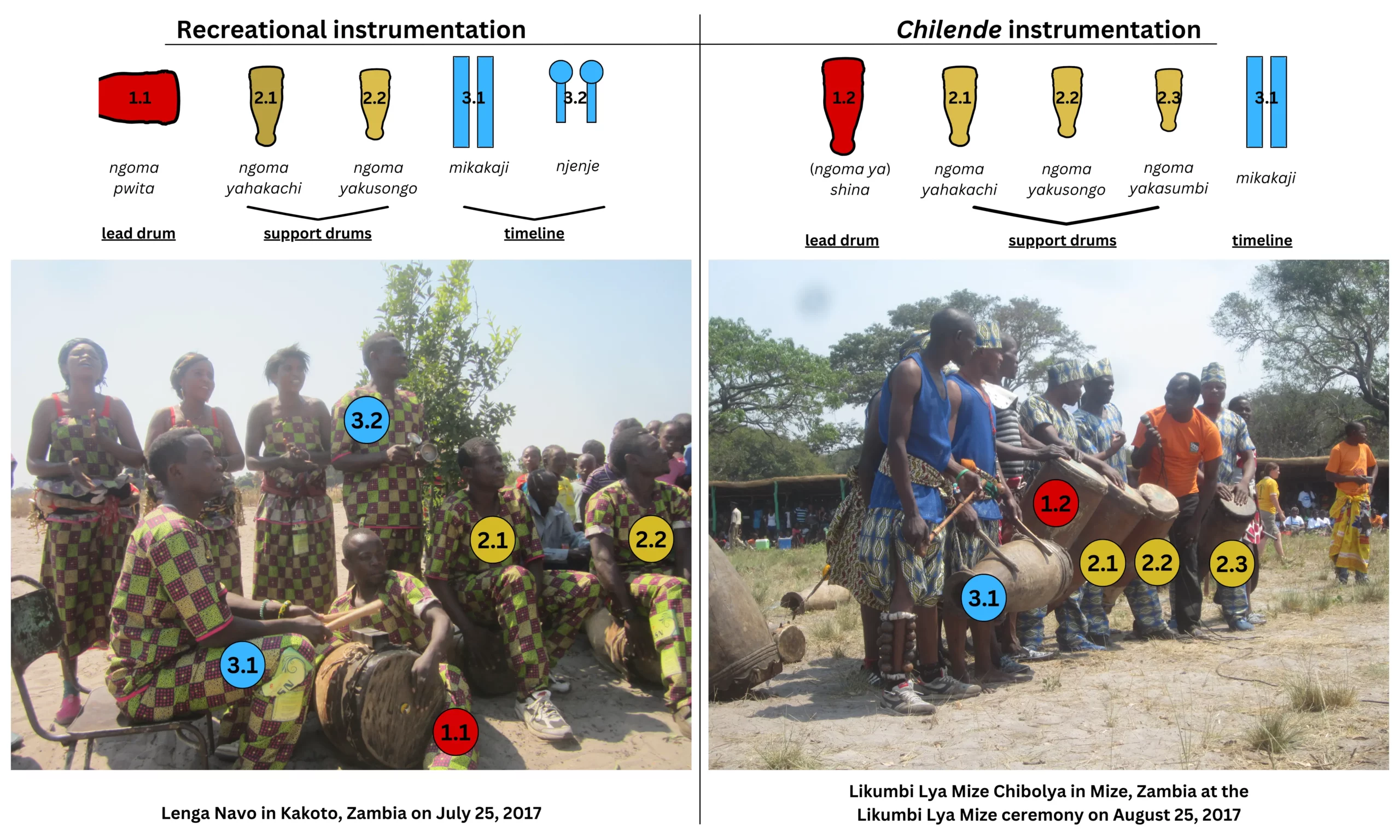
At the heart of most makishi musical settings is the ngoma drum. It is a long, hollow, cylindrical/conical, single-headed drum usually beaten with hands. Versions of this drum are widespread throughout central and southern Africa. The preferred materials for the Luvale ngoma drum are mukula (pterocarpus angolensis) wood and cow skin. Far from the flora of the Northwestern Province, ngoma drums in Lusaka are often instead constructed with the lighter and less resonant white wood. While the wood body of a drum may last for decades, the skin drumhead does occasionally need to be replaced due to the natural wear and tear of vigorous performance. The wood bodies are usually carved and painted by skilled woodworkers with experience making drums. Lower tuned versions (such as the ngoma ya shina, ngoma pwita, and ngoma yahakachi) usually have a wider, more protruding body than higher drums. The carving process may take anywhere from a few weeks to several months depending on the speed of the woodworker. Though some heads may also be affixed by these same craftsmen, this is often the job of the drummer or drum owner. To affix the head, one must first soak the cow skin in water for several hours. It is then stretched over the drum and nailed in place with about 9-15 jimbambo (thin pegs). The head then dries in the sun for a few hours before the skin is shaved. In the Luvale tradition as well as throughout this region, the word “ngoma” carries several meanings. Among them are drum, musical event, dance music, a dance event, and traditional healing ritual. When referring to an instrument, other words are often attached to “ngoma” for specification. However, this naming process must be further explained.
Note on Instrument Names
Unlike many other percussion ensembles in Sub-Saharan Africa, the names of the instruments in the Luvale ensemble are not standardized. I suspect this is the case for four reasons. (1) Several of these instruments are the same ngoma drum with varying sizes and amounts of tuning paste. A drum may be the lead in one ensemble or the lowest support in another depending on the other drums present and how they are each tuned. So, one drum may have a different name in a different setting. (2) There are two common ensemble configurations: what I call shina (or chilende) instrumentation and pwita (or recreational) instrumentation. The former involves three supporting drums while the latter has two. Musicians often name drums based on their physical orientation within the ensemble. For example, the lowest support drum for pwita configuration is called “ngoma yahakachi” which means “middle drum” because it is in between the lead and high support drums. But when that same drum plays the same pattern in shina configuration, it is no longer in the middle. (3) Some of these instruments themselves are not standardized. For example, a timeline pattern may be performed on bottles, metallic poles, or bicycle bells. Musicians may refer to the instrument differently depending on its material. Finally, (4) due to the similarity of the cultures of these ethnic groups, makishi music is performed in multi-ethnic settings. For example, Luvale and Chokwe musicians may drum alongside each other as they accompany a Luchazi likishi in a primarily Mbunda mukanda (traditional male initiation school). Each language has its own names for instruments – some of which may already be affected by the previous three naming complications. Though musicians can keep track of the parts that must be covered on which drums, precise instrument names may differ. In these settings, knowledge of the musical requirements or utilization of vocables are vital. For these reasons, I provide alternate names. I urge the reader to focus more on the role an instrument plays rather than its name.
(ngoma ya) shina
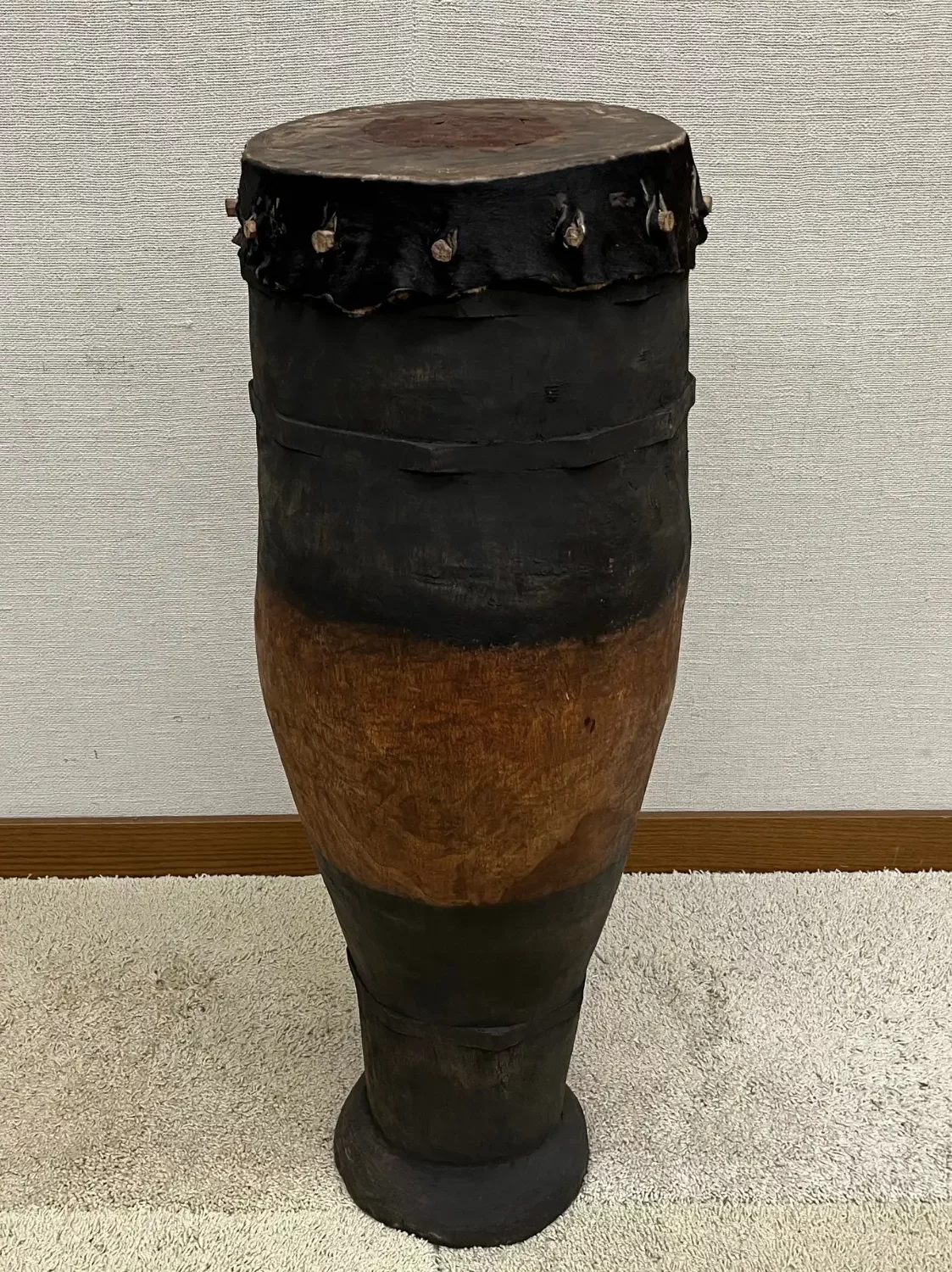
The shina is one of two primary lead drums for makishi music. Of the settings for spirit dances, the shina is usually employed in vilende (large dancing events). When it is the lead drum, a third supporting drum (ngoma yakasumbi) is usually added to the ensemble. In ensembles led by the shina, all drummers perform standing up. To do this, they either “wear” the drums around their waists (with the help of ropes) or lean the drums against a specially crafted structure (mitondo ya jingoma). Like most other Luvale ngoma drums, the shina is played with hands rather than sticks. The shina has a lower sound than the supporting drums due either to its larger size, higher quantity of applied ulezo, or a combination of these factors. It is often referred to in English as a “buzz drum” due to its timbre. Proficient shina drummers can exploit the drum’s resonant potential, making the shina‘s rumbling vibrations audible from a great distance. Unlike the supporting instruments in the ensemble, the shina can stop, rest, and restart during a piece. Shina performance is improvisatory and responds to dance and other ritual action. Its vocabulary is highly dependent on the performer; each drummer may have a different set of phrases they base performance on. The main job of this instrument is to control dance. In vilende, the master drummer may move with the shina away from the rest of the ensemble, towards the dancer. It is not uncommon to see a passionate shina drummer rolling on the ground with his drum while playing!
Alternate names: ntangi, chipwali
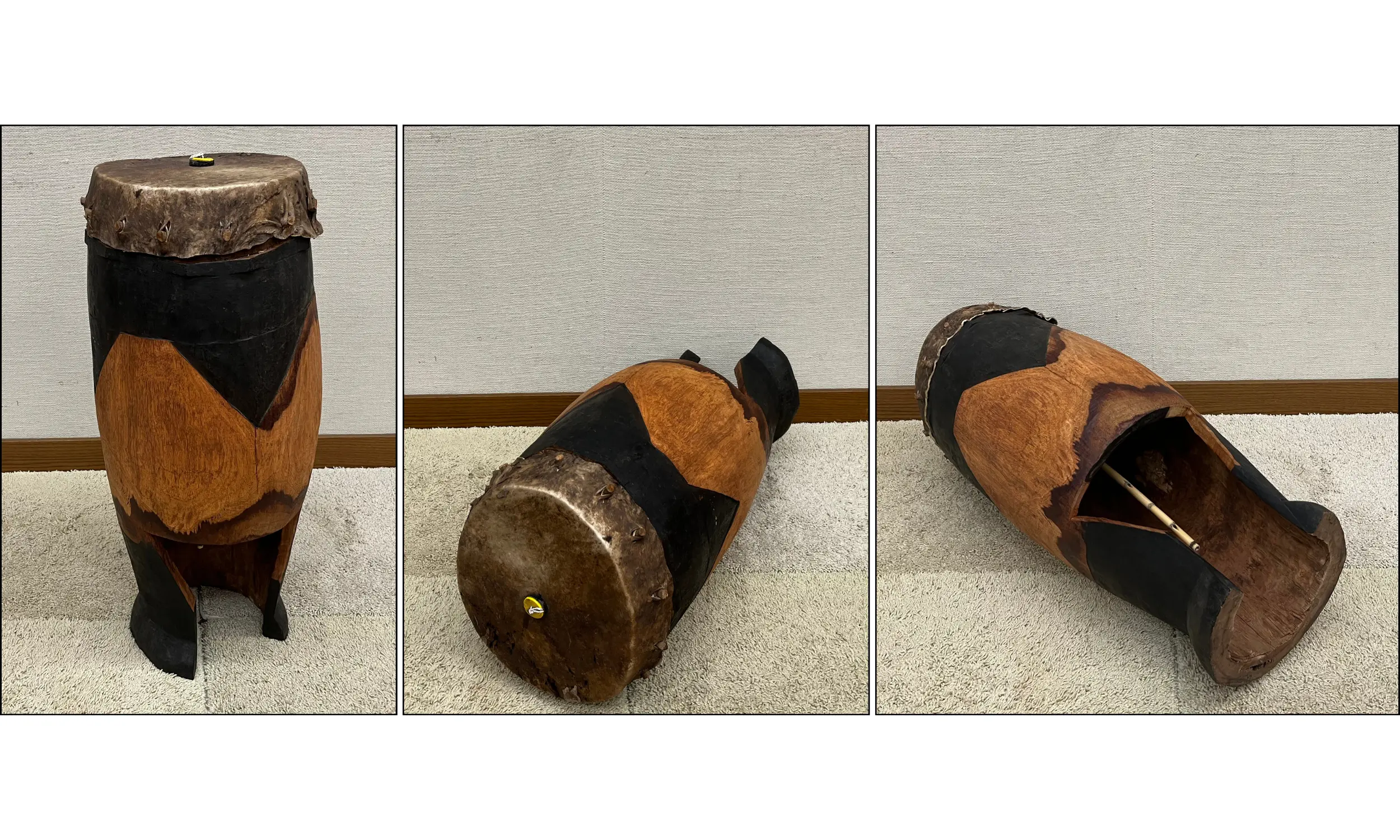
ngoma pwita
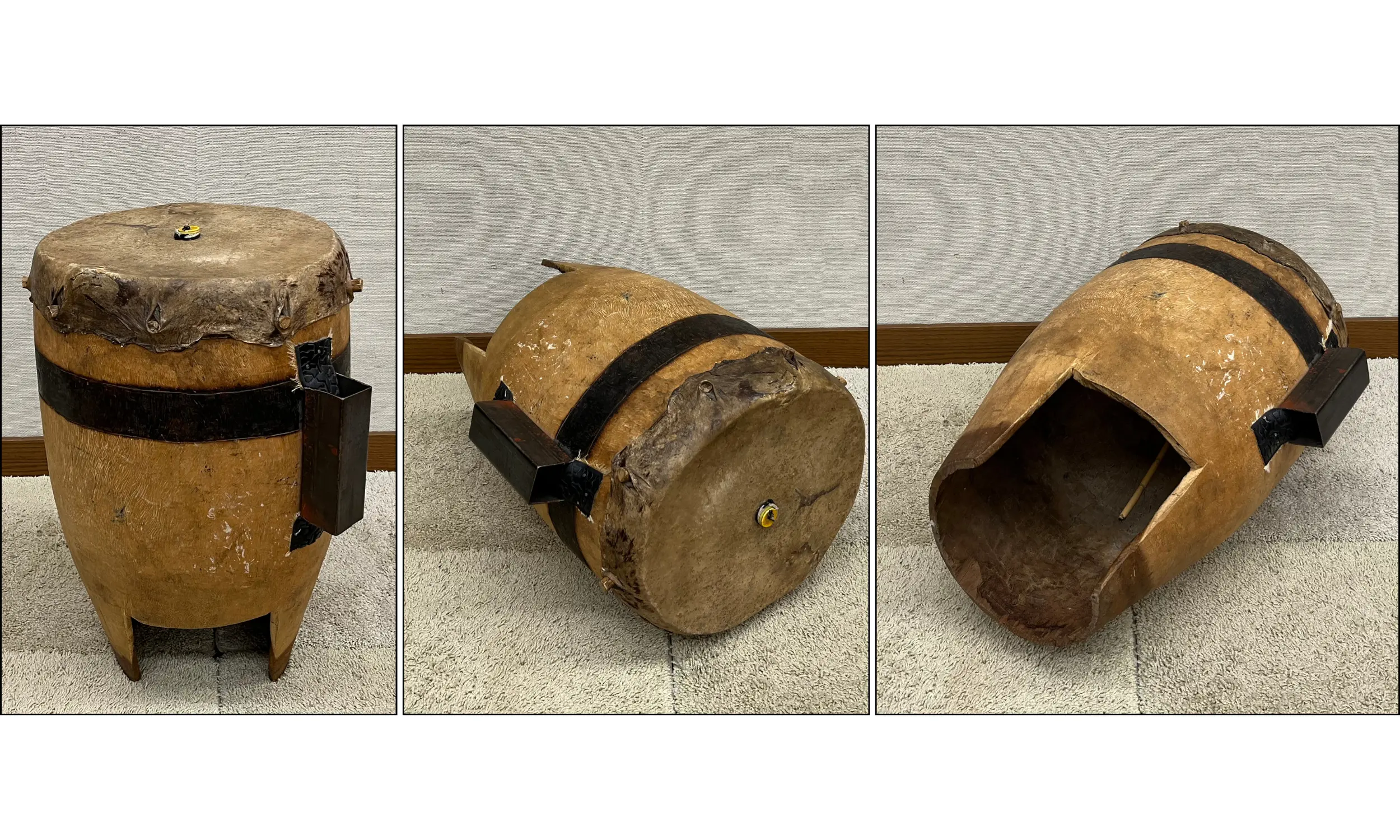
with added surface for mikakaji
mikakaji
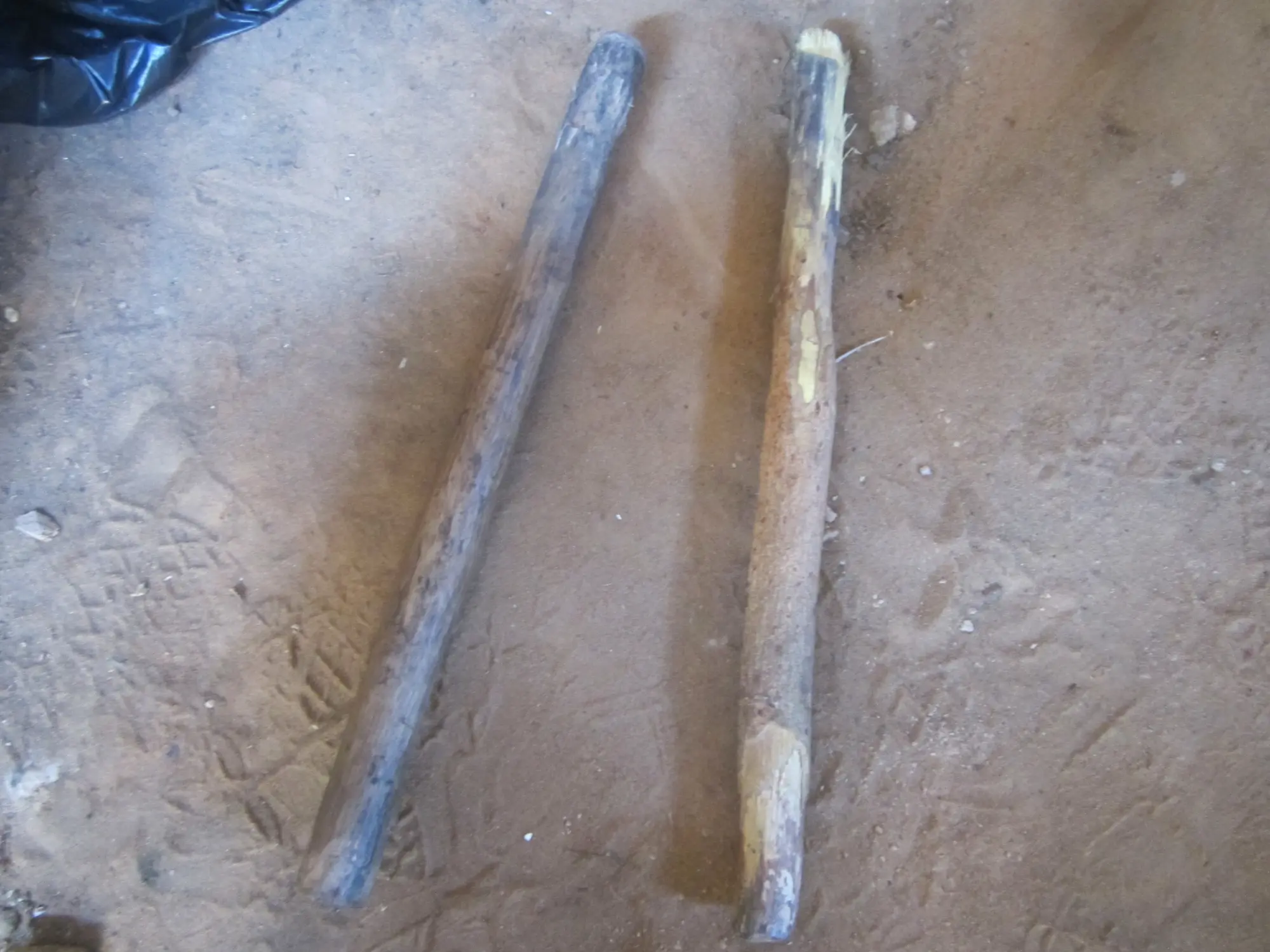
The mikakaji are present in percussion ensembles regardless of whether ngoma ya shina or ngoma pwita is the lead drum. They are a pair of two similarly sized sticks (roughly an inch in diameter) that are knocked against the side of a drum (Kubik 2008, 358).2 In performance, the strong hand plays a timeline pattern while the weak hand fills in the remaining fastest pulses (Kubik 1972, 173).3 In addition to articulating this important rhythmic phrase, the mikakaji also help push the ensemble’s tempo. They do not stop playing at any moment in a song. With rare exception (such as improvised breaks in dances like Chiyanda or Mwokolo), the mikakaji never vary their parts. In the Kachacha dance, it is common for there to be 2 mikakaji players, each with their own pair. In these settings, one player will perform the timeline (strong hand) and remaining fastest pulses (weak hand) while the other articulates a shuffled rhythm.
Alternate names: mingongo, mikalala
ngoma yahakachi
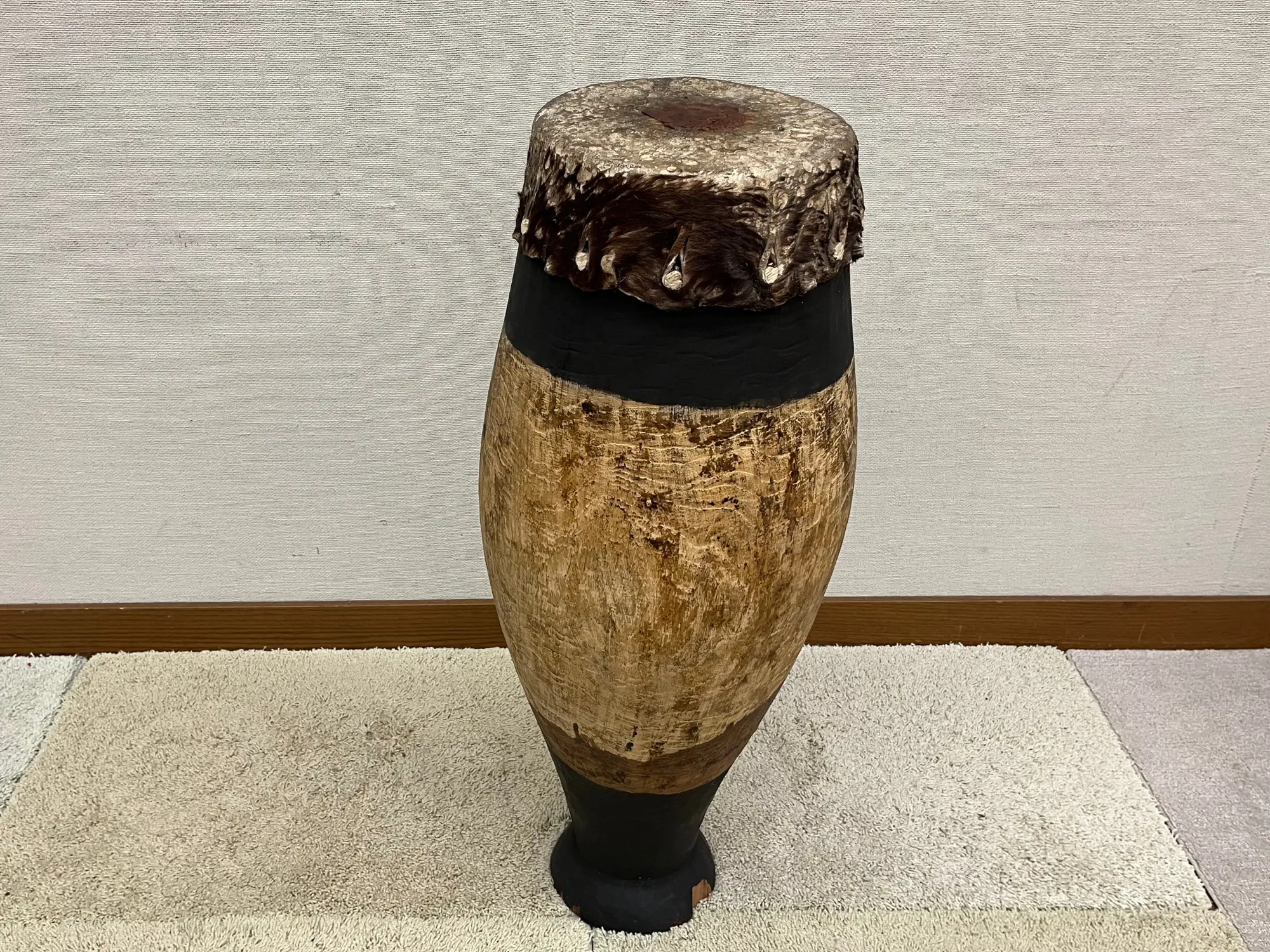
The ngoma yahakachi (middle drum) is the lowest-pitched support drum. Its pitch is higher than that of the shina, though. It is essentially a shina but with less ulezo and/or a slightly smaller size. The ngoma yahakachi is present in both types of ensembles (shina- or ngoma pwita-led). It plays a part that interlocks with ngoma yakusongo to create a unique composite that defines the item of repertoire. Like the mikakaji, this drum plays continuously. In several dances, the ngoma yahakachi is permitted a great deal of variation.
Alternate names: chimpululu, mukundu, mukhundu, mukhundu wa kuvunga, mupundu
ngoma yakusongo
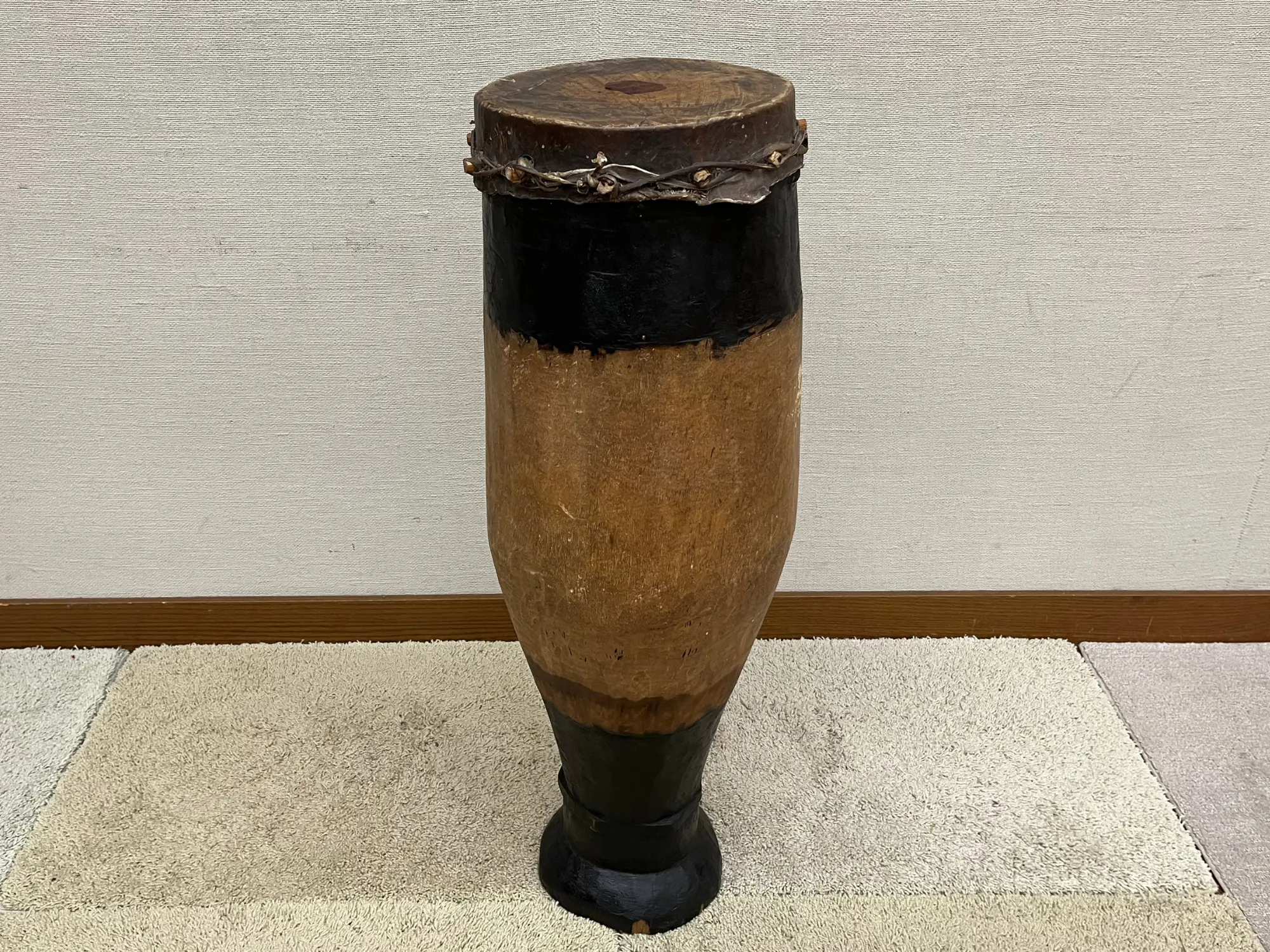
The ngoma yakusongo (last drum) is a support drum with a higher pitch than ngoma yahakachi. It is essentially ngoma yahakachi but with less ulezo and/or a slightly smaller size. The ngoma yakusongo is present in both types of ensembles (shina– or ngoma pwita-led). It plays a part that interlocks with and cuts across the ngoma yahakachi to create a unique composite that defines the item of repertoire. Akin to the lower support drum, the ngoma yakusongo plays continuously. Though variation is permitted on this drum, yakusongo drummers tend to vary their parts less than they do on ngoma yahakachi.
Alternate names: chimpululu, mukundu, mukhundu, mukhundu wa kusasulwiya, mupundu
ngoma yakasumbi
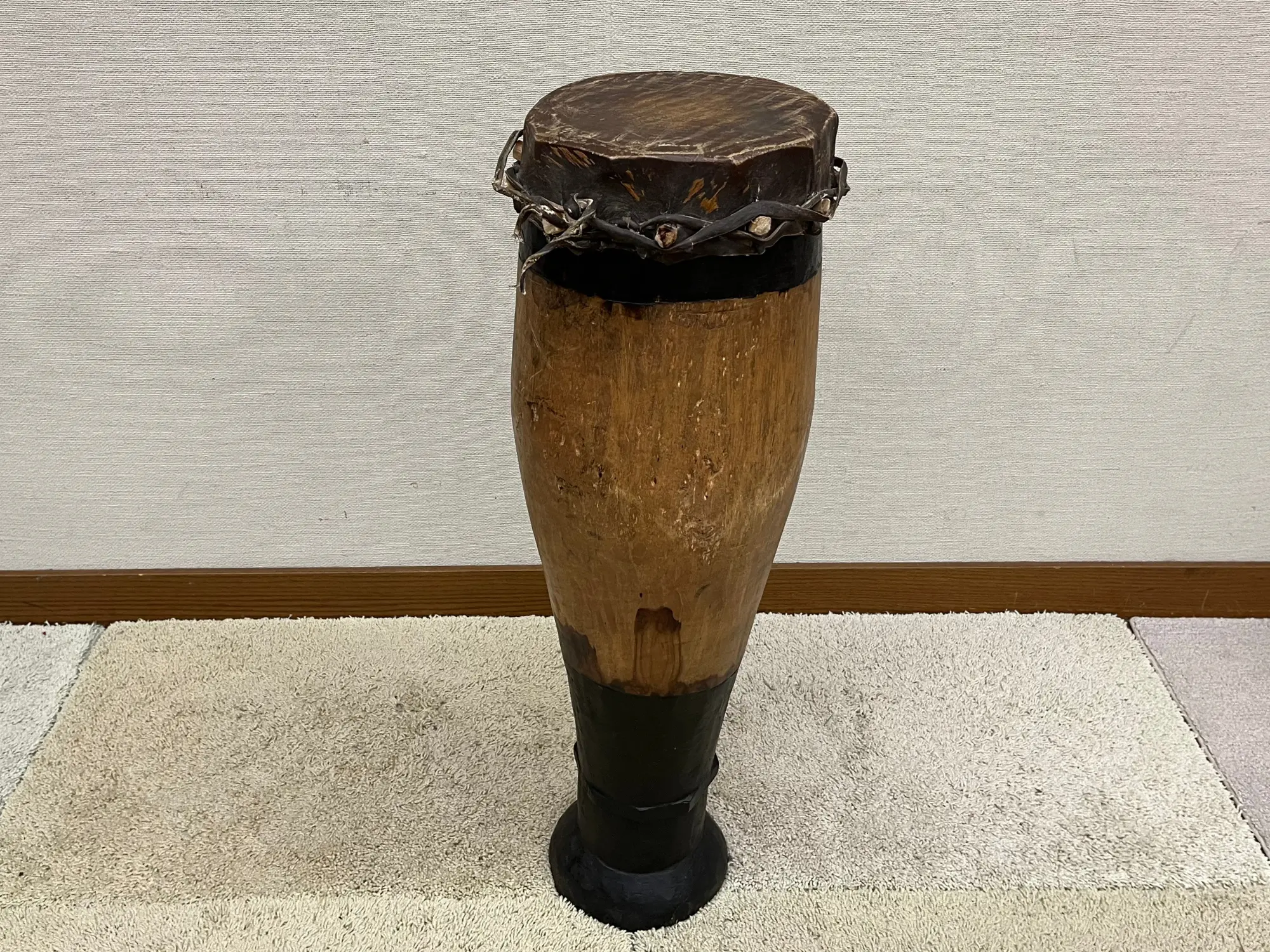
The ngoma yakasumbi (chicken drum) is the highest pitched support drum. It is essentially ngoma yakusongo but with less (if any) ulezo and/or a slightly smaller size. The ngoma yakasumbi is usually only present when shina is the lead drum. As such, it is a frequent fixture in vilende but rarely accompanies friendly makishi such as Mwana Pwevo. Depending on the item of repertoire, this drum either (1) cuts across the yahakachi–yakusongo composite, (2) contributes to that composite, or (3) articulates the beat. Akin to the other supporting instruments, the ngoma yakasumbi does not stop playing. It is usually permitted the least amount of variation of the supporting drums.
Alternate names: ngoma yakasulasongo, ngoma yakusongo (when the middle support drum is called ngoma yahakachi)
njenje
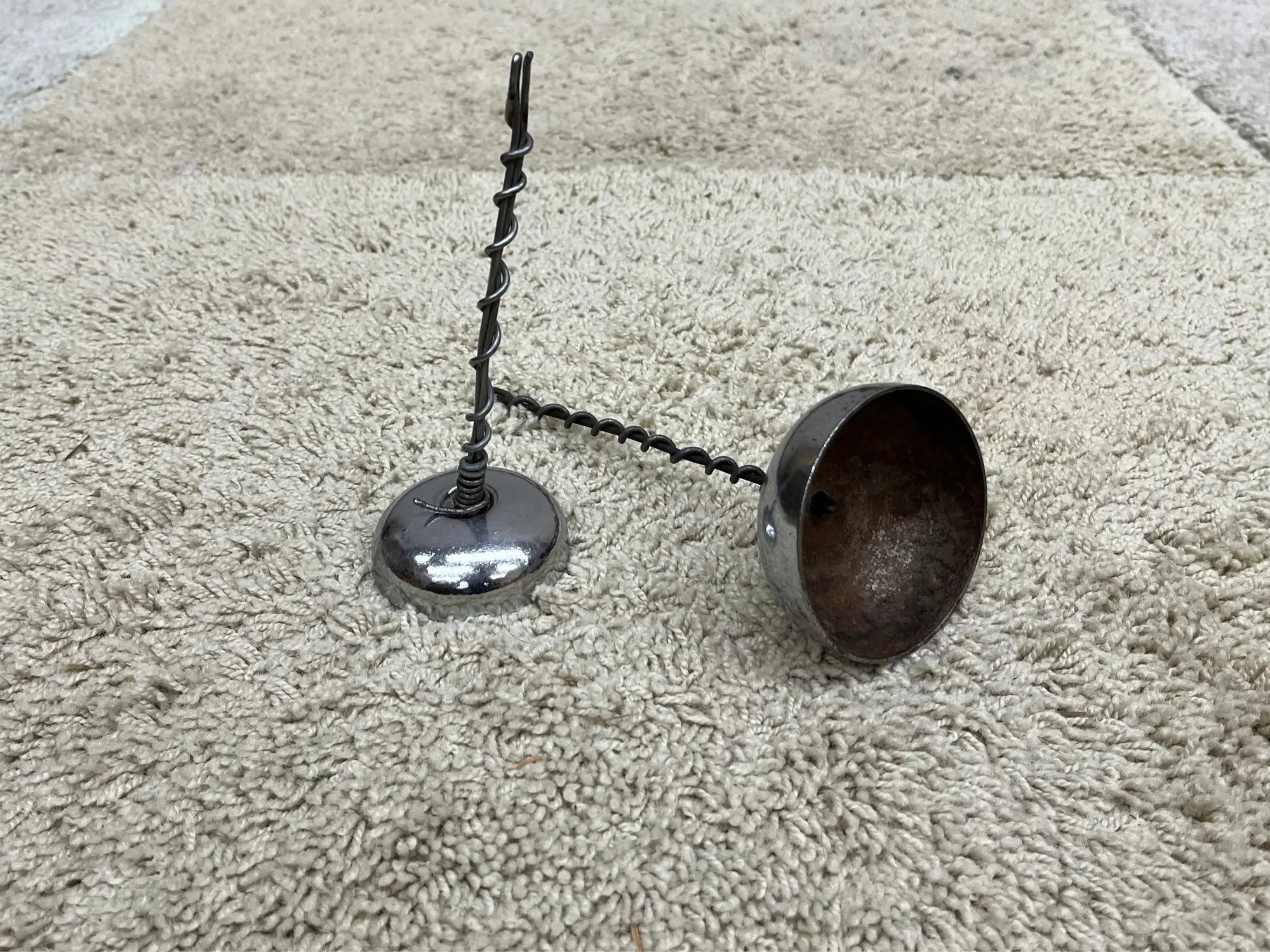
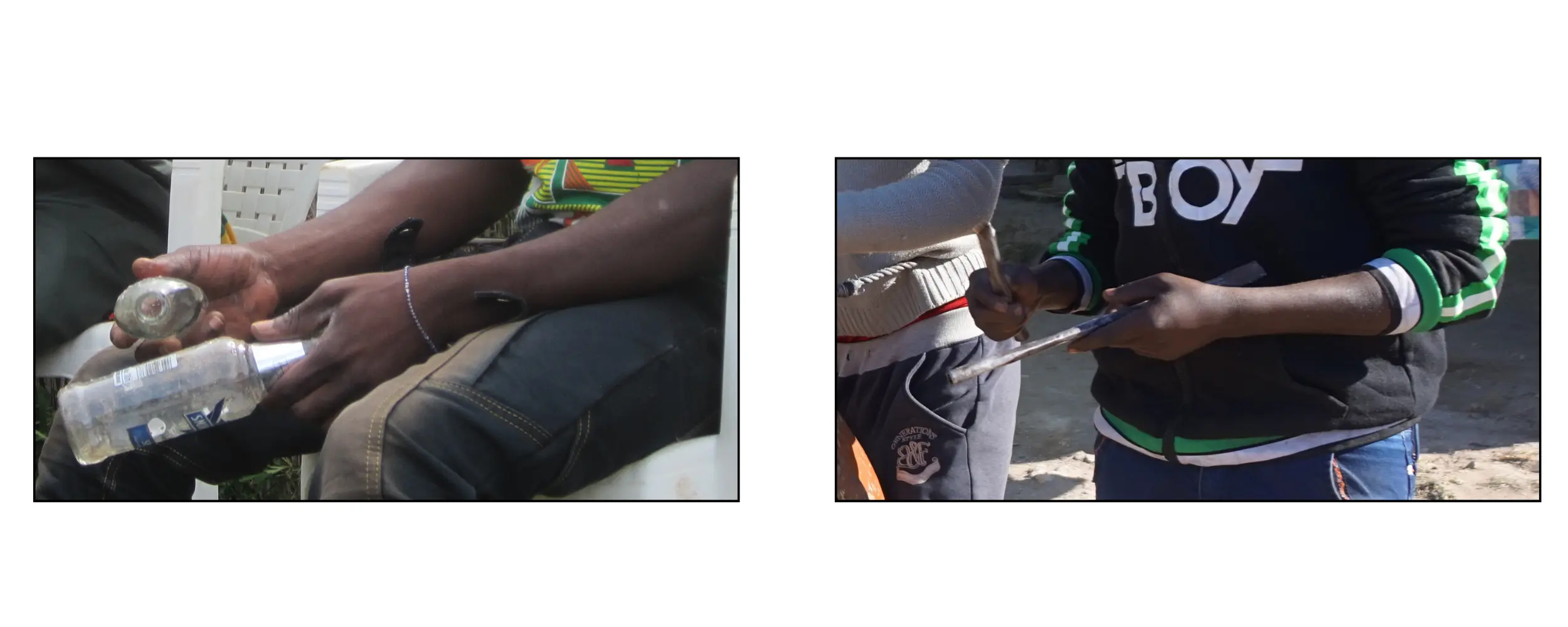
from (L) Zambezi, Zambia and (R) Lusaka, Zambia
Though not present in all Luvale percussion settings, the njenje is rare in non-Vaka Chinyama musics and, as such, is a sonic marker of Luvale culture. The instrument is a frequent fixture in ngoma pwita ensembles, and occasionally featured in shina-led ensembles. It is perhaps the least standardized component of the Luvale percussion world. When its presence is desired, numerous items can fill its role including bicycle bells attached to wire sticks, glass bottles, short metal rods, silverware on glass bottles, and other materials capable of producing a bright timbre. Whatever it is fashioned out of, njenje performance involves striking one object against the other. It usually articulates the timeline pattern and, as such, doubles the strong hand of the mikakaji. Unlike the mikakaji, though, the njenje does not also articulate the remaining fastest pulses. It is thus less concerned with pushing tempo than the mikakaji. Its role is to spice up the timeline pattern. The njenje usually plays for the entirety of the song with little pause, though some variation is permitted.
Alternate names: mingonguela (if fashioned out of bottles), chingongo
kapyololo
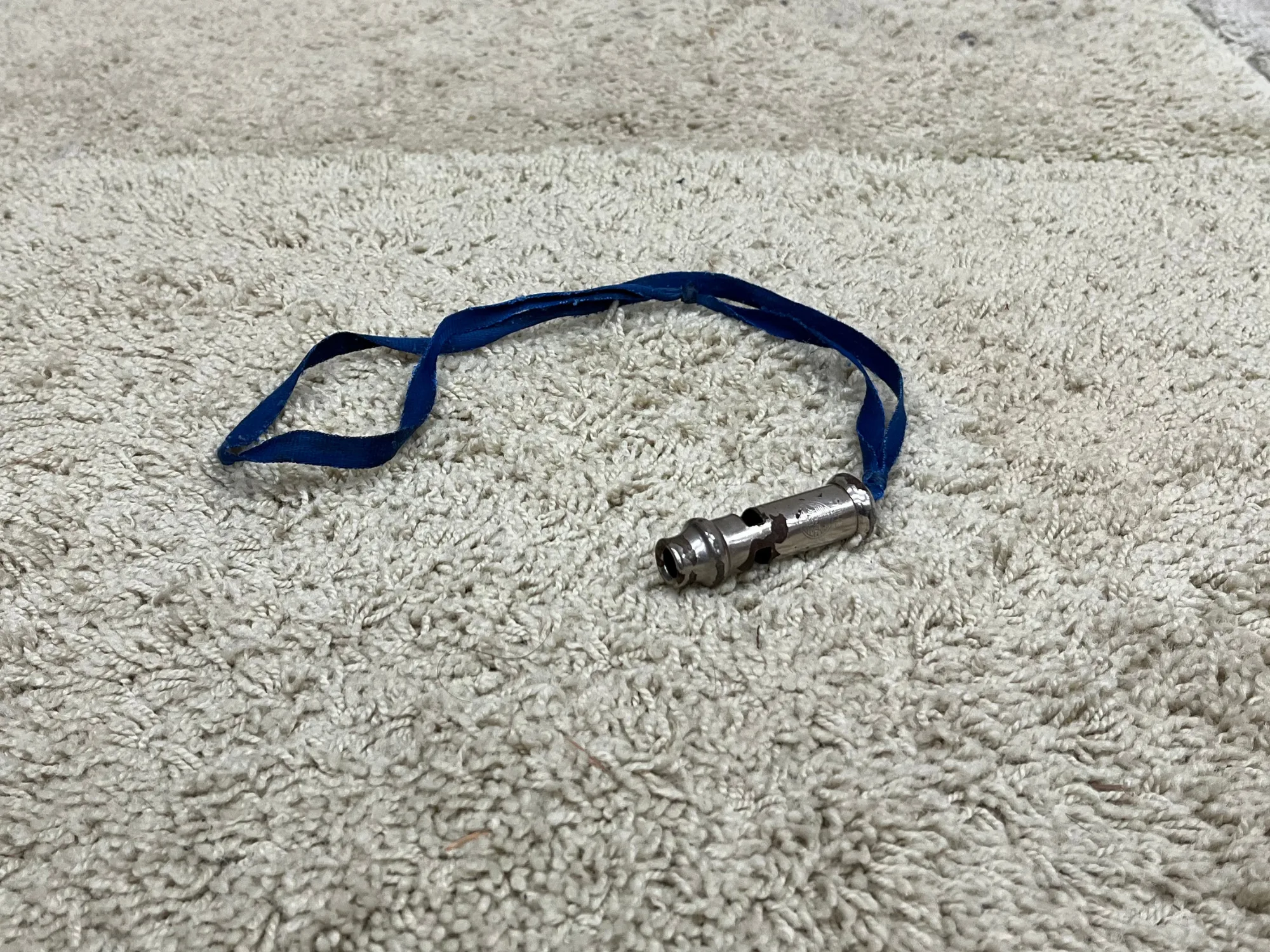
Although it is not formally a part of the ensemble, many Luvale musical events would be considered incomplete without the kapyololo (whistle). The whistle likely only recently entered the culture during the colonial period. It was initially used primarily for the Luchazi dance of Nyakasanga which originated in mining towns. It has since become a staple of many makishi musical settings. In ngoma pwita-led ensembles, a musician (oftentimes the pwita drummer or mikakaji player) will wear and blow the whistle while playing. Alternatively, the likishi fronting the group (especially if Mwana Pwevo) or any other featured dancer may take on this responsibility (Jordán 2018, 372).4 In musical settings led by the shina, however, it is usually the onlookers (especially vanyatundanji – mothers of boy initiates) who wear and blow whistles. Here several people may sport whistles at once. The kapyololo does not have a set vocabulary. Instead, its wearer will blow patterns that match lead drum phrases, generally fit the music, or compliment dance moves. Though excited onlookers may blow their own whistles out of sync from the music at any moment as a way of increasing energy, the kapyololo is more often saved for the main dance sections of pieces which usually occur after the song or a vocal interjection. As such, it is not a constant presence in a piece and will stop and restart often.
(ji)sangu
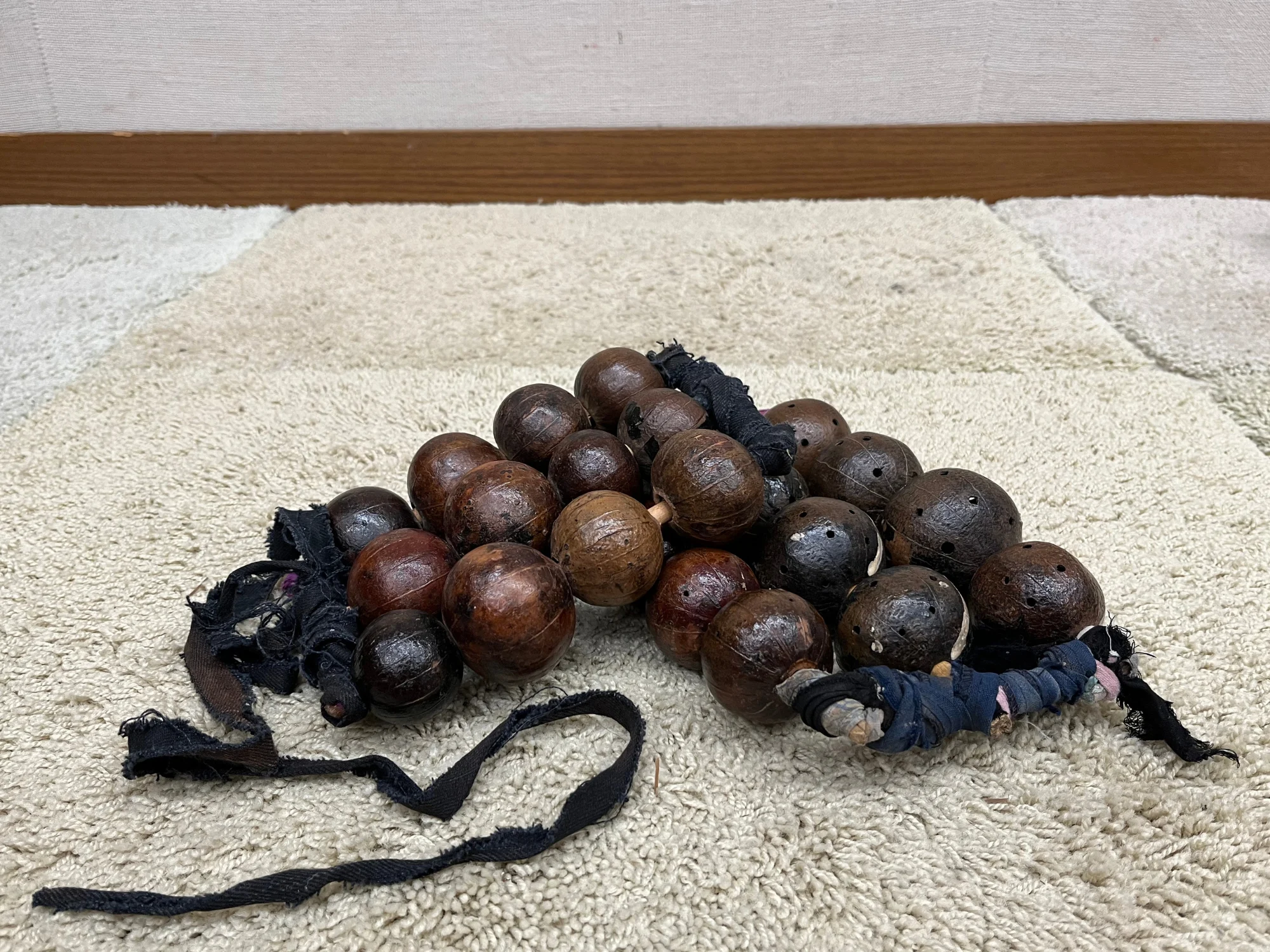
made by Kapalu Lizambo
The jisangu (or sangu, singular) are another informal sound-producing item. “They are made of round, hard-shelled fruit, pierced with a number of little holes, which come from the munzenze tree” (Bastin 1992, 29).5 Though occasionally shaken by hand, these rattles are usually tied around legs to sound sympathetically with select dance steps. Certain makishi (such as Mwana Pwevo) always wear jisangu. For others, it is a matter of performer preference. In ngoma pwita-led ensembles, featured dancers will frequently sport jisangu. Though any dancer movement has the potential to send the jisangu into motion, the most intense shaking comes during dance sections (after the song or a vocal interjection). During these sections, certain dance styles will sound jisangu more than others. As a result, waist-shaking moves may sound different than styles involving steps or stomping. In ceremonial vilende settings, almost anyone can wear the rattles. Akin to the kapyololo, in these settings the jisangu are less for accentuating certain moves or musical moments, they are instead utilized more to boost general excitement. As the Likumbi Lya Mize Traditional Ceremony Facebook account states, “to show that you are part of the festivities, you are expected to tie the rattles on your legs. Everyone who wears the rattles is identified as being part of the celebrations…we wear the rattles to show that we are part of the celebrations and ready to jive to the Ngoma”.6 Unlike other instruments on this site which are owned by a group leader, palace, or village, most Luvale will keep a pair of jisangu in their own homes.
ngezo
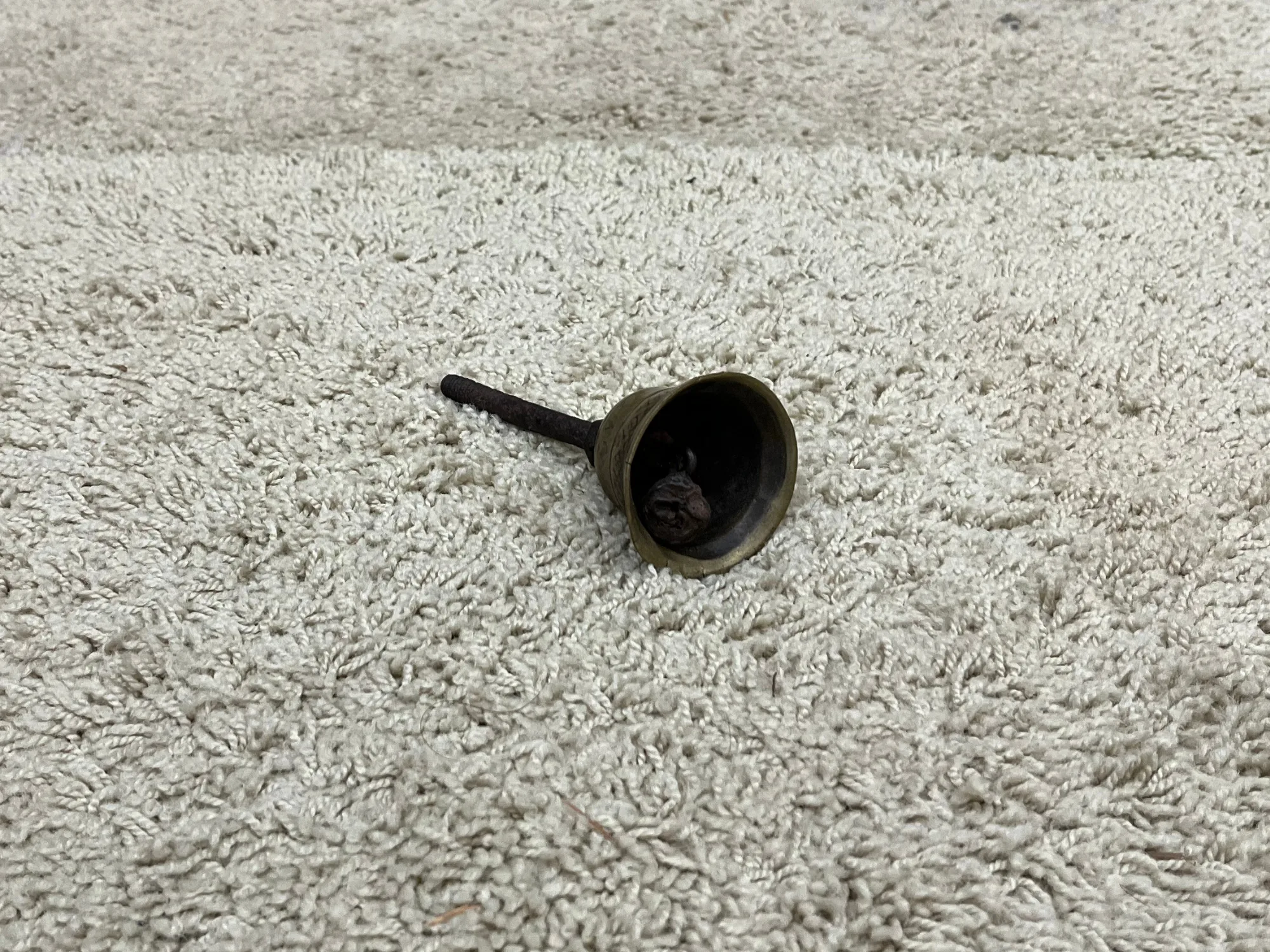
This small bell is rare in modern use. In the past, some makishi were expected to hold the ngezo and shake it when entering a village. Now it is more common to attach the bell (without its stick) to the chiwamba (dancing waist belt) worn by sociable makishi. In this way, it behaves similarly to jisangu worn by dancing makishi by sounding with certain dance moves. Additionally, the ngezo may be shaken during events that feature makishi such as likosa. It is also a common presence in rituals that rid the afflicted of mahamba spirits. In all of these settings, this small bell adds a touch of the spiritual. Bastin (1992, 30) theorizes that this is an adoption of the Portuguese guizo bell.7
Alternate name: ngenzo
ndamba
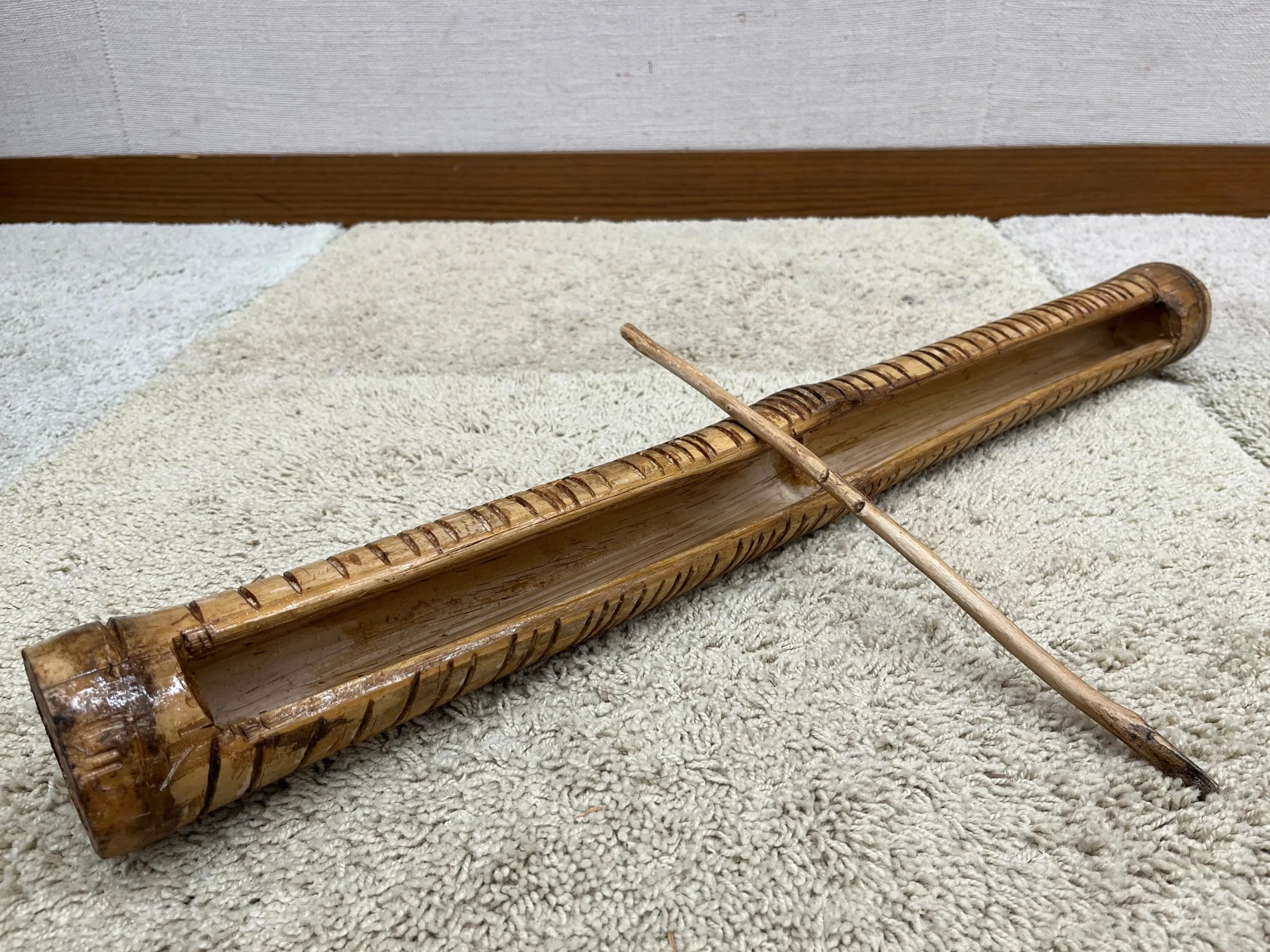
made by William Vunda
- Kubik, Gerhard. 2008. “Central Africa: An Introduction.” In The Garland Handbook of African Music, 2nd ed., 328–61. New York: Routledge.
- Kubik, Gerhard. 2008. “Central Africa: An Introduction.” In The Garland Handbook of African Music, 2nd ed., 328–61. New York: Routledge.
- Kubik, Gerhard. 1972. “Oral Notation of Some West and Central African Time-Line Patterns.” Review of Ethnology 3 (22): 169–76.
- Jordán, Manuel. 2018. “Masks and Musical Instruments.” In Congo Masks: Masterpieces from Central Africa: A Book and Catalogue, 370–73. New Haven: Yale University Press.
- Bastin, Marie-Louise. 1992. “Musical Instruments, Songs and Dances of the Chokwe (Dundo Region, Lunda District, Angola).” Journal of the International Library of African Music 7 (2): 23–44.
- Likumbi Lya Mize Traditional Ceremony. 2024. “WHY LUVALES WEAR JISANGU.” Post. Facebook. https://www.facebook.com/photo/?fbid=945365633668438&set=a.470617554476584.
- Bastin, Marie-Louise. 1992. “Musical Instruments, Songs and Dances of the Chokwe (Dundo Region, Lunda District, Angola).” Journal of the International Library of African Music 7 (2): 23–44.